IS YOUR SELF STORAGE FACILITY ACCESSIBLE? New Rules for Self Storage Construction and Renovation Under the Americans With Disabilities Act
Introduction:
Title III of the Americans with Disabilities Act of 1990 (ADA) prohibits private entities from discriminating against individuals with disabilities by maintaining places of business that are not physically accessible. The Act requires that places of public accommodation remove architectural barriers that limit access to or use of the public place. The term “public accommodation” in theADAgenerally encompasses all private businesses that offer goods and services to the public, including self storage facilities.
Order the INDOOR ADA SELF STORAGE KIT for only $69.95 plus shipping
Click here and print out the measurement instructions, for the OUTDOOR SYSTEM. No orders will be shipped without correct measurements entered in text area of shopping cart!
MEASUREMENTS REQUIRED BEFORE YOU ORDER THE OUTDOOR SYSTEM!
Order the OUTDOOR ADA SELF STORAGE KIT for only $269.90 plus shipping
Although self storage operators are currently subject to all the ADA building access regulations applicable to structures generally, the 2010 Standards included space accessibility “scoping requirements” that provide that facilities must identify a specific number of units as assessible to be compliant. Based on these Standards, storage operators need to consider if they have thoroughly inspceted their property forADAcompliance and whether a property audit is required.
The Standards:
Existing buildings, alterations and new construction are all within the scope of theADA’s public accommodation provisions. TheADArequires that small businesses remove architectural barriers in existing facilities when it is “readily achievable” to do so. Readily achievable means “easily accomplishable without much difficulty or expense.” This requirement is based on the size and resources of a business. So, businesses with more resources are expected to remove more barriers than businesses with fewer resources. Readily achievable barrier removal may include providing an accessible route from a parking lot to the business’s entrance, installing an entrance ramp, widening a doorway, installing accessible door hardware, repositioning shelves, or moving tables, chairs, display racks, vending machines, or other furniture. In 2010 the Department of Justice issued new Standards of Accessible Design. The 2010 Standards lay out accessibility design requirements for newly constructed and altered public accommodations and commercial facilities. Certain dates in the construction process determine whichADAstandards – the 1991 Standards or the 2010 Standards – must be used. If the last or final building permit application for a new construction or alterations project is certified before March 15, 2012, businesses may comply with either the 1991 or the 2010 Standards. If physical construction starts after March 15, 2012, the business must use the 2010 Standards.
Although self storage operators are currently subject to all the ADA building access regulations applicable to structures generally, the 2010 Standards included space accessibility “scoping requirements” that apply specifically to self storage buildings. The storage space regulations are as follows:
Scoping: 5% if less than 200 units, 10 units + 2% if more than 200.
Dispersion: Disperse the accessible units among “classes” of spaces provided.
Since the term “classes” is undefined, it could mean either the size of a unit or it could mean the type of unit (i.e. climate controlled). If there are more classes than the number of accessible units that are required, operators do not need to have additional accessible units just to have one in each class. There also appears to be no need to disperse the accessible units among buildings in a multi‑building facility. As with hotels, there appears to be no requirment to hold the unit back from rental solely for a disabled customer if other spaces are otherwise rented and the space is needed.
The Compliance and Audit Process:
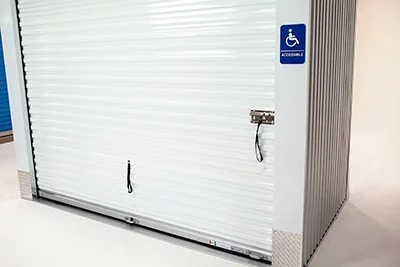
It is clear that storage operators should focus on making sure that they have considered accessibility issues generally for their facility. Operators should take the time now to review if their businesses meet compliance with areas such as entry pad heights, parking spaces, ramps to offices, counter heights and restroom design. But self storage operators must now also consider the accessibility to the unit itself. Does the roll up door meet compliance standards? Does the rain lip prevent access to the space? Is a ramp required?
TheADAis not a building code and Title III of the Act does not have any direct effect on state and local building codes. TheADAallows the U.S. Attorney General to certify that a state law, local building code or similar ordinance that establishes accessibility requirements meets or exceeds the minimum accessibility requirements for public accommodations in commercial facilities. Accessibility compliance can be tested by the Department of Justice as well as private citizens bringing complaints under a private right of action. Self storage facilities that fail to comply with the law by March 2012 may find themselves subject to liability for non-compliance with the law.
The following are some specific areas to address for self storage operators:
- Roll up Doors:
Door Opening Force: “The maximim force for pushing or pulling open a door shall be: 5 pounds.” (TheADAstandards do not address the force required to lift of close a lift-type door).
2. Door hardware: “Handles, pulls, latches, locks and other operating devices on accessible doors shall have a shape that is easy to grasp with one hand and does not require tight grasping, tight pinching, or twisting of the wrist to operate. Lever operated mechanisms, push type mechanisms and U-shapped handles are acceptable designs.” (Questions have been raised about the use of a looped rope to aid in closing the door)
3. Thresholds at Doorways: “Thresholds at doorways shall not exceed ¾ in (19 mm) in height for exterior sliding doors or ½ in (13 mm) for other types of doors. Raised thresholds and floor level changes at accessible doorways shall be beveled with a slope no greater that 1:2” (Is a ramp required to provide access over a rain lip exceeding ½ inches?)
It is important to demonstrate a good faith effort to address these types of assessibility issues on the property. One suggestion is to have a knowledgeable architect perform an accessibility audit of your facility. Through such an audit, operators can discover what areas may require changes and whether those changes are readily achievable based on the costs involved. If the audit is performed though an attorney, the audit can be considered work product and therefore priviledged.